
Smart Start method
Poverty, domestic violence, and other family problems are often passed down from one generation to the next. Although many of these problems can be predicted early on, help usually doesn’t come until the situation has become serious.
Children and parents deserve the best opportunities for a bright future. Smart Start was created based on this conviction: a program that invests in the early identification of risks and the prevention of major problems among children and families.
Smart Start is a collaboration between municipalities in Hart van Brabant, Sterk Huis, Centerdata, Xpect013, Tilburg University, and GGD Hart voor Brabant. We combine available data and knowledge in a smart way and organize preventive, collective solutions in neighborhoods and schools. This allows us to monitor outcomes and scale up successful solutions to other contexts.
Sustainable solutions
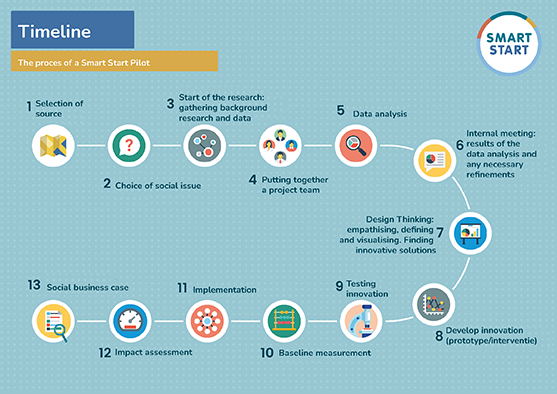
Within Smart Start, we work with pilot projects that each focus on new issues but always follow the same approach. Each pilot goes through several steps: from an initial idea to measuring the effects of the developed innovation. Based on the experience gained, the steps are continuously improved. Centerdata is involved in all parts of this timeline and is primarily responsible for the steps related to collecting and analyzing data (steps 3, 5, 6, 10, 12 and 13).

Better Opportunities for Everyone
Smart Start’s goal is clear: to provide better opportunities and conditions for children, families, and society in the Hart van Brabant region and beyond. By identifying risks earlier and collaborating on preventive measures, a new approach is emerging that prevents problems rather than solving them.
To date, eight pilot projects have been carried out within Smart Start. These have led to new knowledge, methods, and interventions that can be applied collectively, preventively, and sustainably. Reports on the pilot projects can be found in our publication database. More information about Smart Start is available in Dutch on the website
See below a few examples of previous pilot projects:
Smart Start pilot Goirle
How can you use knowledge and experience to determine what is needed to ensure that children in Goirle start elementary school without developmental delays? With that research question, the municipality of Goirle launched a pilot program in 2020.
When a child lags behind their peers—for example, in language development—we refer to this as a developmental delay. To provide every child with equal opportunities, the municipality of Goirle, the child care centers (daycare and elementary school), and health care professionals work closely together to prevent and reduce these delays.
Survey of Families and Professionals
How can we prevent children from falling behind? When is a child at risk? What helps prevent this? And how can we better support families to give their children the best start in life? To answer these questions, we analyzed data on families in Goirle available through Statistics Netherlands (CBS). In addition, a questionnaire was distributed to professionals who work with children aged 0 to 7. Vulnerable children were identified anonymously. Based on the results, the research question was refined. During a design thinking process, we focused on a more specific main question: What do parents in Goirle need to equip their child with sufficient language skills for a successful start in elementary school?
The origins of the ‘Spel & Boek’ concept
The design thinking process in 2022, in which parents and relevant professionals worked together, led to the ‘Spel & Boek’ concept. The first activity took place on 10 January 2024. Since then, residents of Goirle have been able to visit every Wednesday from 10.00 to 11.00 am with their child(ren) for an hour of play and reading. ‘Spel & Boek’ is a collaboration between Dorpsteam Goirle, Taalhuis Goirle and Goirle Library.
What does Spel & Boek offer?
Parents and children can play, read books and listen to a story being read aloud based on a central theme. The storybook is available to borrow so that reading can continue at home. Thanks to Refugee Team, the text is available in several languages, enabling families who speak other languages to follow the story in two languages. Although language development is the main focus, Spel & Boek also offers the chance to meet other parents and share experiences. Participation is free and no registration is required.
Smart Start pilot Livelihood Security
The Smart Start pilot Livelihood Security examines the backgrounds of Tilburg residents facing livelihood insecurity. The goal is to identify ways to support Tilburg residents. To this end, the project combines data analysis from existing sources with design thinking sessions. The research is being conducted on behalf of and in collaboration with the municipality of Tilburg, with close involvement from social partners.
This publication contains a data analysis that provides insight into the characteristics of households with an income below 120% of the statutory subsistence minimum. The analyzed data comes from Statistics Netherlands (CBS microdata) and the City of Tilburg.
Why this research?
For many residents, livelyhood security is unfortunately not a given. Uncertainty about income, housing, and support can lead to stress and problems. To properly support Tilburg’s residents, we want to gain a better understanding of their situation. What do they truly need to regain hope for a bright future—for themselves and for their children?
Smart Start pilot GGD Hart voor Brabant.
Poverty is not just a lack of money, but also a lack of opportunities to participate. Current solutions are mainly aimed at alleviating hardship.
With this pilot, we are focusing on preventing developmental poverty. In the pilot, we are using a combination of data analysis, the practical knowledge of residents and professionals, and Design Thinking to arrive at innovative solutions.